CAT6 BLUE · Division 27
Structured Cabling Contractors for New York Businesses
Cat6, Cat6A and fiber backbone — designed, pulled, terminated and certified by licensed New York crews. Union and non-union options, statewide.
- Cat6 / Cat6A / Cat8
- OM3–OM5 + single-mode fiber
- IDF/MDF build-outs
- Fluke-certified testing
- TIA-568 / TIA-606 compliant
- 25-year manufacturer warranties
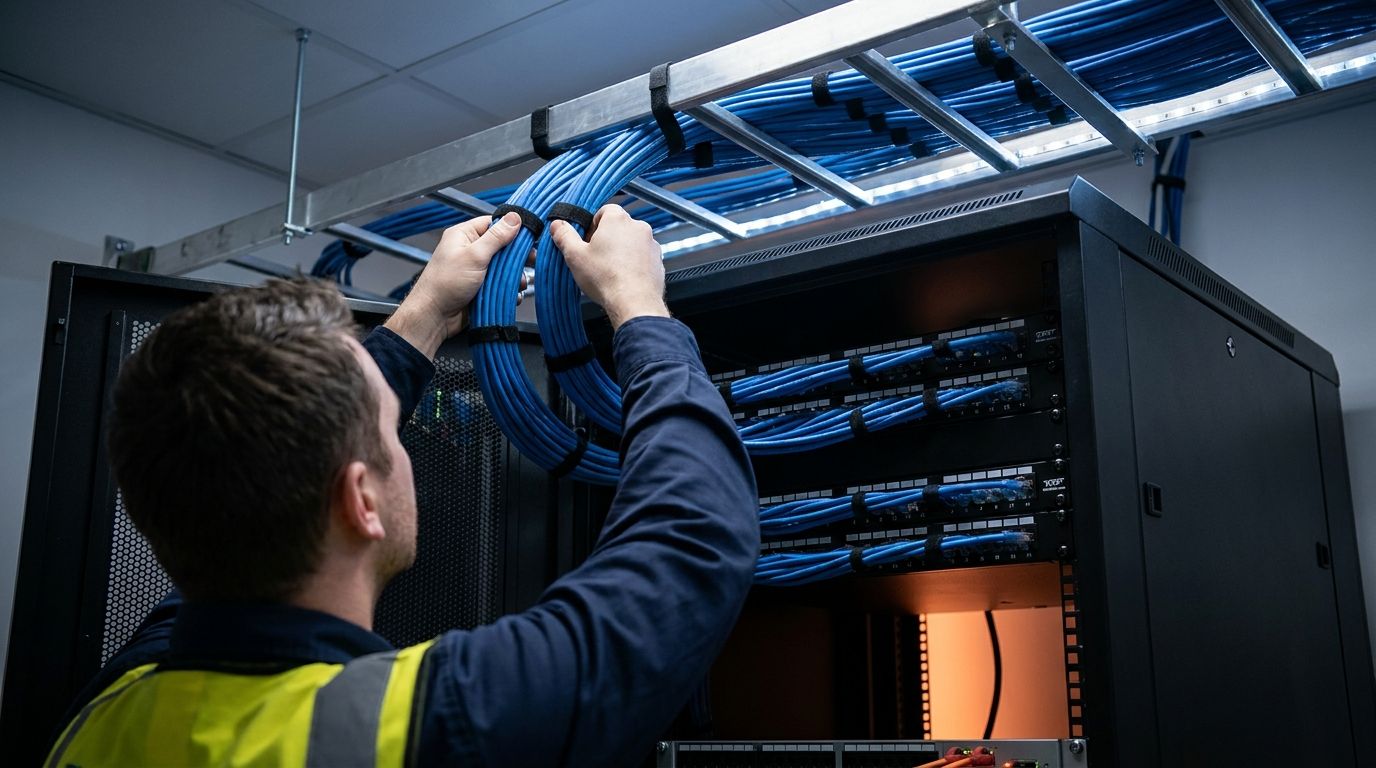
Structured cabling is the physical layer everything else in your building rides on — data, VoIP, wireless access points, cameras, access control, building automation. Done right, it disappears into the walls for twenty years. Done wrong, it becomes a recurring line item: intermittent link failures, drops that won't certify at gigabit, and a rat's nest above the ceiling tile that makes every future move-add-change twice as expensive.
Low Voltage New York is a statewide network of licensed, insured low-voltage contractors. When you bring us a structured cabling project — a floor fit-out in Midtown, a new distribution center outside Syracuse, a Division 27 package on a ground-up build — we scope it against your drawings or a site walk, then match it with a vetted partner crew that has done that exact type of work. Union or non-union, prevailing wage or private, we field the right crew for the job and the jurisdiction.
Every install is engineered to TIA-568 standards: horizontal Cat6 or Cat6A to the work area, copper or fiber backbone between IDFs and the MDF, proper pathway and support, and telecom rooms built out with racks, ladder rack, patch panels and cable management that a technician can actually work in. Every link gets Fluke-certified, labeled to TIA-606, and documented — so the plant you pay for is the plant you can prove.
What a structured cabling project includes
A complete structured cabling scope runs from the demarc to the desktop. Our partner crews handle design and engineering support, rough-in coordination with the GC and electrician, cable pull and termination, and closeout documentation. On new construction we work from the Division 27 spec and respond to RFIs; on retrofits we field-verify pathways before quoting so there are no surprises above the ceiling.
- Horizontal cabling — Cat6, Cat6A or Cat8 drops to workstations, APs, cameras and printers
- Backbone cabling — multi-strand fiber or copper trunks between the MDF and each IDF
- Telecom room build-outs — racks, cabinets, ladder rack, patch panels, grounding and bonding
- Pathway and support — J-hooks, cable tray, sleeves, conduit stubs, firestopping at penetrations
- Testing and certification — Fluke DSX channel testing with results delivered for every link
- Labeling and as-builts — TIA-606 labeling at both ends plus patch panel schedules and floor plans
How scoping and pricing work
Send us your floor plans, your drop count, or just your address — we return a scoped estimate within 48 hours. Structured cabling prices out primarily per drop, adjusted for cable category, average run length, ceiling type and height, plenum vs. riser rating, and how much pathway has to be built versus reused. A 100-drop Cat6 job in an open-ceiling office quotes very differently than the same count through hard-lid corridors in a pre-war building, and we'll show you exactly why in the line items.
For bid work, we quote against the Division 27 specification as written and flag substitutions up front rather than burying them. For occupied offices, we price the after-hours premium honestly instead of hiding it in the unit cost.
Standards, testing and certification
Our network only carries crews that certify their work. That means BICSI-trained technicians, installs that follow TIA-568 for performance and TIA-569 for pathways and spaces, and 100% Fluke certification — not spot-checks — with test results included in closeout. Where the project calls for it, partner crews hold manufacturer certifications that let them register the installed channel for a 25-year manufacturer warranty covering both product and application.
That documentation matters at the moment you least want to discover it's missing: when a link fails, when the auditors come through, or when the next tenant's IT team asks what's actually in the walls.
Projects we route every week
- Office fit-outs and relocations
- IDF/MDF closet build-outs
- New construction Division 27 packages
- Multi-floor re-cabling and cleanup projects
Coverage
Structured Cabling by region
New York City
Cabling in Manhattan, Brooklyn, Queens, Bronx & nearby
Long Island
Cabling in Hempstead, Melville, Hauppauge, Farmingdale & nearby
Westchester & Hudson Valley
Cabling in White Plains, Yonkers, New Rochelle, Mount Vernon & nearby
Capital Region
Cabling in Albany, Schenectady, Troy, Saratoga Springs & nearby
Central New York
Cabling in Syracuse, Utica, Rome, Liverpool & nearby
Western New York
Cabling in Buffalo, Rochester, Niagara Falls, Amherst & nearby
Southern Tier
Cabling in Binghamton, Ithaca, Elmira, Corning & nearby
FAQ
Structured Cabling — Common Questions
How much does structured cabling cost per drop in New York?
It depends on cable category, run lengths, ceiling conditions and labor market — a Cat6 drop in an accessible-ceiling suburban office costs meaningfully less than a Cat6A plenum run in a Manhattan high-rise with after-hours access rules. Union labor and prevailing-wage projects also price differently than open-shop work. Rather than quote a misleading flat number, we scope your actual conditions and return a per-drop price within 48 hours.
How long does a typical office cabling project take?
A 50–100 drop office fit-out typically installs in one to two weeks once materials are on site, assuming normal ceiling access. New construction runs on the GC's schedule — rough-in during framing, trim and termination after walls close, testing before turnover. Occupied-space retrofits done after hours take longer in calendar days but avoid disrupting your staff. We give you a schedule with the estimate, not after the deposit.
Do you offer union crews for structured cabling work?
Yes. Our network includes both union and non-union licensed contractors across New York State, so we can staff buildings with union labor requirements, prevailing-wage public work, and open-shop private projects. Tell us the labor requirement when you request the estimate and we match the crew accordingly — it affects price, so we'd rather know up front.
Do I need permits for structured cabling work?
Requirements vary by municipality and by what the cable serves. Standard voice and data cabling often doesn't require its own permit, but code still governs plenum ratings, riser ratings, firestopping at rated penetrations, and support methods — and fire alarm or ERRCS-related cabling is always permitted work. Our partner crews are licensed in their jurisdictions and handle whatever filings the local authority requires.
What warranty comes with a structured cabling installation?
Two layers. Every install carries the contractor's workmanship warranty on labor and terminations. On projects specified with a single manufacturer's end-to-end channel, certified partner crews can register the system for a 25-year manufacturer warranty that covers the installed link's performance to spec. We'll tell you at scoping time whether your project qualifies and what it adds to cost — usually little or nothing if the spec is already single-vendor.
Pricing a structured cabling project?
Tell us what you need. A licensed New York crew prices it — free, within 48 hours.