FIBER ORANGE · Division 27 · New York City
Fiber Optic Cabling Contractors in New York City
Serving Manhattan, Brooklyn, Queens, Bronx, Staten Island and every commercial corridor in New York City.
- Fusion splicing
- OM3 / OM4 / OM5 multimode
- OS2 single-mode
- Backbone and riser runs
- Campus and OSP fiber
- OTDR + insertion loss testing
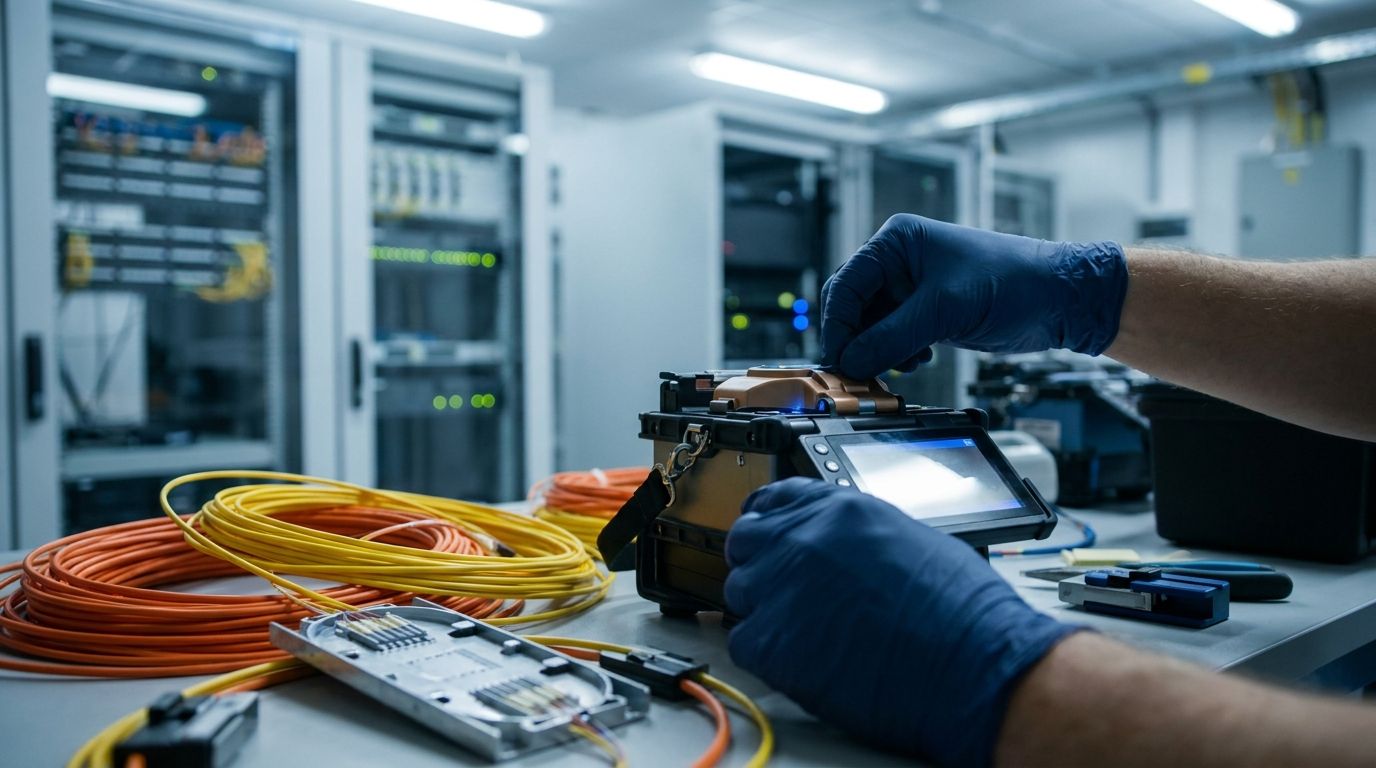
Fiber is the vertical circulatory system of New York's commercial buildings — the riser backbone that carries every tenant floor back to the MDF, the laterals that bring carrier services up from the basement point of entry, and increasingly the horizontal medium for bandwidth-heavy tenants in media, finance and healthcare. Our partner crews run single-mode and multimode fiber through NYC buildings daily: riser pulls coordinated with building management, fusion splicing done in place, and every strand OTDR-tested with results in the closeout documentation.
City fiber work rewards crews who respect the building as much as the glass. Riser space in older Manhattan towers is contested territory governed by riser managers and decades of accumulated cable; pathway between buildings — for campuses, hospitals and connected properties — raises conduit, roof-route and right-of-way questions that need answers before anyone quotes a price. We scope the pathway reality first, then engineer strand counts and termination points with room for the tenant demand that always arrives sooner than expected.
Fiber Optic Cabling where you are
A distinctly New York engagement is the building fiber upgrade as a leasing weapon: owners of older office stock backboning their properties with new single-mode risers so every floor can be offered as connectivity-ready space, wired-certification friendly and carrier-diverse. Our crews execute those upgrades in occupied buildings — riser work staged floor by floor, splicing scheduled around tenant operations, and documentation that lets the leasing team put specifics in the marketing package.
Our New York City partner crews regularly work Midtown and Hudson Yards office core, Financial District and World Trade Center campus, Downtown Brooklyn and the Brooklyn Navy Yard and the surrounding commercial areas — so mobilization is measured in days, not weeks.
What the work includes
Vertical backbone is the classic case: multi-strand trunks from the MDF up through the riser to each floor's IDF, sized with spare strands because pulling fiber twice costs more than pulling extra once. For campuses — hospitals, schools, industrial sites, multi-building offices — partner crews run single-mode between buildings through existing duct banks or new conduit, handling the wet-to-dry transition, grounding of armored cable, and slack loops at each end.
Single-mode is the default for any new backbone or campus run: the cable itself is cheap, distance limits effectively disappear, and it won't be the reason you re-cable in ten years. Multimode still makes sense inside data rooms and for short runs where existing optics dictate it — we'll match what your switching hardware actually needs.
- Riser backbone trunks, MDF to IDF, with spare-strand planning
- Campus and building-to-building runs in conduit, duct bank or aerial
- Entrance facility transitions, grounding and slack management
- Armored, indoor/outdoor and plenum-rated cable selection to match the pathway
FAQ
Fiber Optic Cabling in New York City — Questions
Can you add fiber capacity in an occupied NYC office tower?
Yes — occupied-building riser work is standard practice for our city crews. Pulls and splicing get staged through the riser closets floor by floor during approved windows, coordinated with the riser manager where the building has one, and no tenant's existing services are touched without a scheduled, communicated cutover.
Do you do fusion splicing and OTDR certification on site?
Yes. Splicing happens in place — riser closets, entrance facilities, wherever the architecture calls for it — and every strand gets OTDR-tested after termination. You receive the test results with closeout, so there's a verified baseline for every link the day the project ends.
What drives the cost of a fiber optic cabling job?
Strand count, run length and pathway condition dominate. A 12-strand riser trunk through open sleeves is a quick job; the same trunk through packed cores that need boring, or a campus run requiring trenching and new conduit, is mostly a pathway project with fiber at the end of it. Splicing and testing scale with strand count. We break all of this out in the estimate so you can see where the money actually goes.
Should I install multimode or single-mode fiber?
For new backbone and any building-to-building run, single-mode (OS2) is almost always right — the cable cost difference is trivial, distance limits vanish, and it stays useful through every future speed upgrade. Multimode OM4/OM5 remains sensible for short in-room runs where your existing optics are multimode and replacing them would cost more than the cable. We'll look at your switch hardware before recommending.
Need fiber in New York City?
Tell us what you need. A licensed New York crew prices it — free, within 48 hours.